
Best Vancouver, BC Real Estate Websites 2026–2027: A Newcomer’s Guide

Wherever you are moving from, you almost certainly have a property website you know by heart — the one that carried every listing, showed you what things sold for, and had a map that worked properly. Canada has no single equivalent, and your first fortnight searching for a home in Vancouver will largely be spent discovering that.
The listings exist. The trouble is that they are spread across competing platforms, the information you assumed came free often does not, and the one thing you most want to know — what comparable homes actually sold for — takes real effort to uncover.
The five sites below are the ones you will end up using. The first is a name you may already know, and it is the one most likely to waste your time.
Why Canadian Property Search Works Differently
Listings in Canada sit on the MLS® System, a network of regional databases run by real estate boards rather than by any single company. Only licensed brokerages may display that data. This is why Canada never produced one dominant consumer portal in the way many countries have, and why you will end up using more than one site.
The bigger adjustment concerns sold prices. In much of the world, completed sale prices are a matter of public record, published free and surfaced by every property site. British Columbia does not work this way: sale prices are not open data, and most platforms ask you to register for a free account before revealing them.
What is freely published is the assessed value of every property, produced annually by BC Assessment, the provincial valuation authority. An assessment is not a market price — it reflects a valuation date well before you read it — but it is a useful check against an asking price, and it is the closest thing the province has to the public sale records you may be used to.
One more thing to calibrate: pace. Well-priced homes in Metro Vancouver can be under contract within days. How quickly a site emails you about a new listing is therefore a genuine feature, not a detail.
1. Zillow
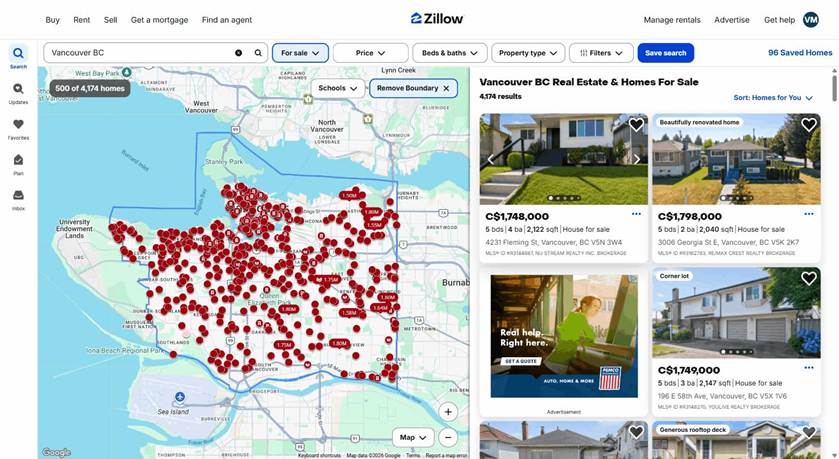
Zillow, Vancouver BC, no filters applied.
The reflex for anyone who has searched for property in the United States, and a familiar name well beyond it. Zillow does carry Canadian listings, and finding what is for sale is not really the problem — run the same Vancouver search across these five sites and Zillow returns broadly what the Canadian ones return.
Understanding any of it is the problem. The Canadian pages are an American product with Canadian listings poured into them, and the features that make Zillow useful in its home market do not cross the border. Open a Vancouver listing and you find:
Valuations. The Zestimate, the number Americans lean on, renders as a blank dash.
Price and tax history. Both report as unavailable.
Climate risk. A link to somebody else’s website rather than anything Zillow tells you.
Advertising. Inside the results grid, and again beside the listing.
Schools. This is the one that gives the game away. The three “nearby schools” come back as Point Roberts Primary, Birch Bay Home Connections and Blaine High — all of them in Washington State, between seventeen and twenty-four miles away, scored by an American ratings database. No Vancouver School Board catchment school appears at all.
If you are relocating with children that last one matters more than it first appears, because for most families the school decides the neighbourhood and the neighbourhood decides the house. Starting that chain from the wrong end is how people end up somewhere that does not work.
Walk Score and Bike Score do function, because those are international measures. Very little else local does.
Use it for orientation if it is what you know. Do not make decisions on it. Redfin has the same problem.
2. EstateBlock
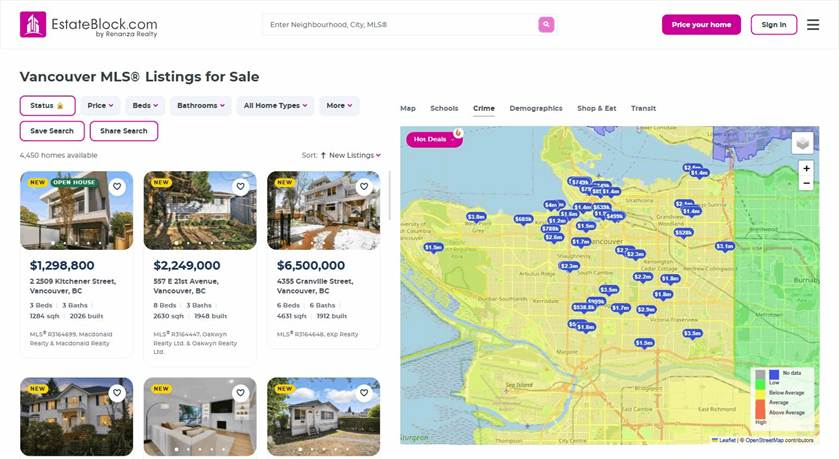
The crime layer switched on over the listings, so neighbourhood data and asking prices sit on one map.
If the best Vancouver, BC real estate website is the one that answers the question newcomers actually struggle with — is this a neighbourhood I want to live in? — then this is the strongest of the five. It is the most feature-dense platform here, and the only one built primarily around choosing an area rather than browsing houses.
The organising idea is that you stop researching a neighbourhood across separate browser tabs and switch data layers on over the listings map instead. A few of those layers matter more from abroad than they would to someone already living here.
Crime. A heat map separated into violent and property crime. With no local knowledge this is the hardest thing to establish from overseas, and the thing you are most likely to get wrong by asking strangers on a forum.
School catchments. Schools appear as rated catchments rather than whatever happens to sit nearby. The distinction is easy to miss and expensive to get wrong: in Vancouver the school a child is entitled to attend follows the address, and the nearest school and the assigned school are frequently not the same one.
Transit. Matters disproportionately if you are arriving without a car, which most people do for the first few months at least. Seeing SkyTrain and bus reach against a specific listing tells you whether you could function there before you have bought one.
Daycare. On the same map, which sounds mundane right up until you are arranging childcare in a city you have not landed in yet, from eight timezones away.
Languages spoken. The demographic layers show which languages are spoken in each area. That sounds like trivia and turns out to be among the most used features for people moving from abroad — Vancouver has large Mandarin, Cantonese, Punjabi, Tagalog and Korean-speaking communities, and whether you would rather be inside one or outside it is a real question that a map can actually answer.
Environmental screening. Listings are checked automatically for flood risk, road and rail noise, power line proximity and agricultural land status. This is precisely the local knowledge that takes residents a decade to accumulate and that no newcomer knows to go looking for.
Two further features have no equivalent among the others here.
Deal-finding filters. Homes priced below their BC Assessment value, listings that have just taken a significant price cut, court-ordered sales, and an algorithm flagging homes priced well under comparable sales nearby. Most platforms let you sort by price; this lets you search for mispricing, which is a different thing entirely — and it is most valuable exactly when you have no instinct yet for what a fair price in this city looks like.
Rent against carrying costs. A filter for properties where estimated rent would cover the monthly cost of ownership. If there is any prospect of being posted elsewhere in a few years, that single number decides whether you could hold the place and let it out, or would be forced to sell into whatever market happens to exist that year.
Published cashback. Commission rebates do exist in Canada — the seller normally pays both agents, and some agents will return a share of theirs to the buyer — but they are almost always negotiated privately, one conversation at a time, after you have already committed to working with someone. EstateBlock publishes the figure on every listing page before you speak to anyone.
For a newcomer that transparency is worth more than the rebate itself. You have no local network to ask what is normal, and no way of knowing whether the number you are quoted is the going rate or the rate for someone who has just arrived.
Coverage is British Columbia only, which is the trade-off for the depth.
3. REALTOR.ca
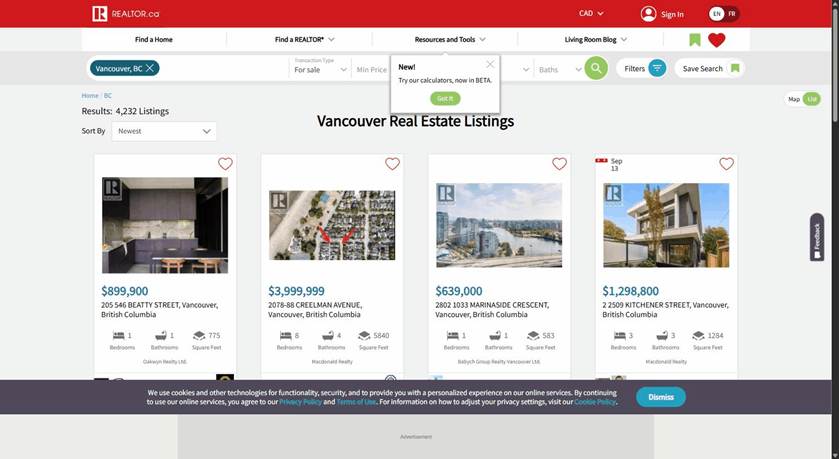
Complete coverage, presented as a plain index of what exists.
The official national site, run by the Canadian Real Estate Association, aggregating the MLS Systems of every board in the country. It has the most complete listing coverage available anywhere.
That completeness is worth more to a newcomer than to anyone else. A local searching a familiar neighbourhood will notice if something is missing. Arriving from abroad you have no way of knowing what you have not been shown, so having one site that is definitionally complete is a useful backstop.
Its limits are the price of neutrality. Sold-price history is minimal, neighbourhood context is thin, and there is nothing resembling analysis. Treat it as an index of what exists rather than a research tool.
4. REW
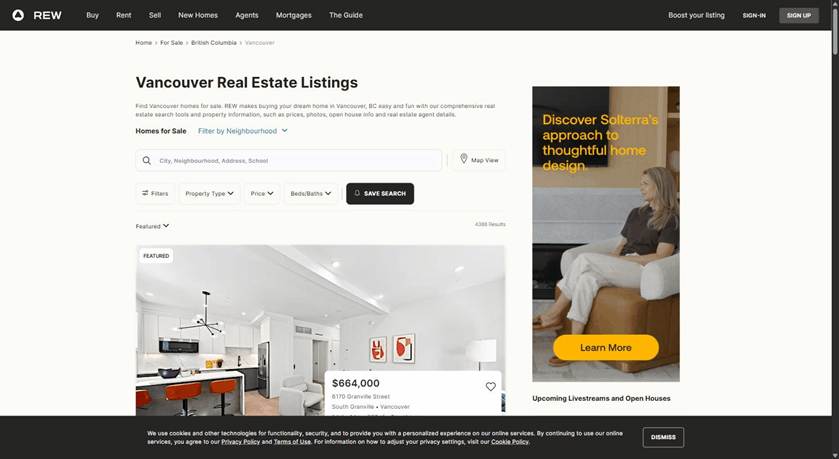
REW, the strongest of the general British Columbia specialists.
The strongest of the general regional specialists for British Columbia. REW has an arrangement with BC Assessment allowing it to display property data and sales history for residential properties across the province.
That sales history is the fastest way to build a price instinct you do not yet have. Asking prices tell you what sellers want; a run of completed sales on comparable homes tells you what the city actually pays, which is the calibration most newcomers are missing in their first month.
Its coverage of new-build and presale developments is also unusually thorough. This suits a common newcomer pattern: arrive into a rental, spend a year working out which areas you like, then buy a presale that completes once you are certain you are staying.
Outside BC it is much weaker, but for this province it earns its place.
5. Zoocasa
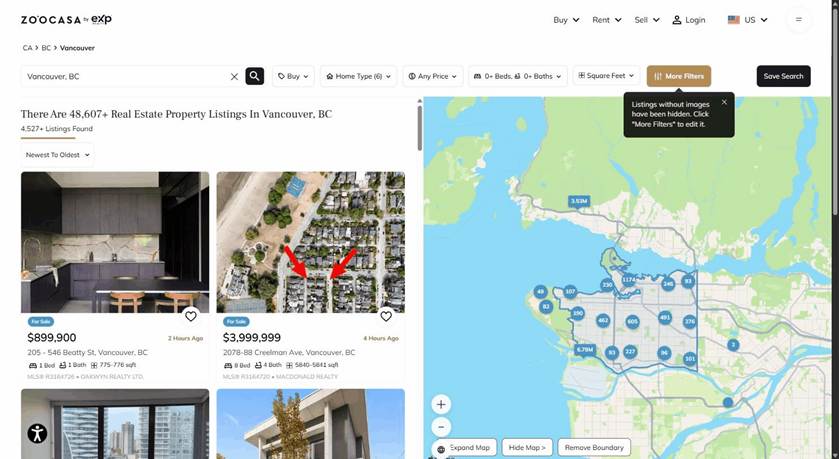
Zoocasa, a national all-rounder now owned by eXp.
A national platform that is also a licensed brokerage, now part of eXp World Holdings. It offers sold price history across British Columbia, algorithmic home value estimates it calls Zoopraisal, and custom alerts.
The detail worth noting if you are still overseas is online document signing. Being a brokerage as well as a search site means a transaction can be progressed without you being in the room, which removes one of the more irritating obstacles to buying before you have physically moved.
It also extends into more than thirty American states, which is genuinely useful if you are unwinding a US property as part of the same move rather than running two processes on two continents.
It is a capable all-rounder rather than a specialist. The neighbourhood-level data is thinner than what a BC-focused platform offers, and there is no commission rebate, but if you want sold prices and a brokerage in one place across several provinces it does the job.
How to Use Them Together
No single platform wins everything, and anyone who tells you otherwise is selling something. But the order matters more than the choice, and most newcomers get the order backwards.
Choose the area before the house. Start on whichever platform puts crime, school catchment, transit, demographics and environmental screening on the same map as the listings. Almost every decision in this process is reversible. Where you live is not, and it is the one you will make with the least information.
Layer the data instead of reading about it. Being told a neighbourhood is “up and coming” tells you nothing at all. Seeing property crime shaded across the listings you are actually considering, with the catchment school and the nearest SkyTrain stop on the same screen, settles in a minute what a fortnight of forum posts will not.
Search for mispricing, not just price. Filters for homes below their BC Assessment value, recent price cuts, court-ordered sales and rent against carrying costs do work you cannot do by eye in a market you have never lived in. Sorting by price only tells you what things cost; it does not tell you what is cheap. Of the five compared here, EstateBlock is the only one that offers these as search filters rather than leaving you to spot the pattern yourself.
Register free accounts early. Sold history almost always sits behind a free registration, and you want that access in place before you are making an offer rather than during. It is also worth one pass through REALTOR.ca, the national index, purely to confirm nothing exists that you have not been shown.
Set up saved searches, then test them. Well-priced homes here go under contract in days, so the alert that reaches you first is worth more than the one with the nicer interface. Check how quickly each site actually emails you.
Find out what the commission rebate is before you talk to anyone. In Canada the seller normally pays both agents, and a share of the buyer’s side can come back to you — but as a rule you are only offered it if you already knew to ask. Seeing that figure published on the listing tells you what is reasonable before you are sitting across from someone whose job is to close you.
Do the research photographs cannot show you. Rail noise, floodplain status, which school an address is zoned for, how far the nearest SkyTrain station really is. These are obvious to anyone who has lived here a decade and completely invisible to someone arriving from abroad, and any platform that surfaces them is preventing a mistake listing photos will never reveal.
Where to Begin
If you are still overseas, work broad to narrow. Understand what exists and roughly what it costs, then choose two or three areas and research them properly before shortlisting a single property. Most newcomers do this backwards, falling for a house and only later discovering the neighbourhood does not suit them.
For that research stage, use whichever of these puts crime, school catchment, transit and environmental data on the same map as the listings — which, among the five compared here, means EstateBlock. An afternoon spent that way will teach you more than a fortnight of searching site to site.
The house is the straightforward part of moving abroad. The neighbourhood is what you are really buying, and in a city you have never lived in, that has to be researched rather than guessed.